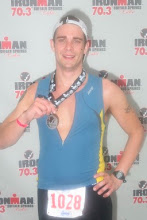
The below is a letter I wrote for my coach to share with all of the new Team in Training members that he will be coaching this season here in the North Dallas Chapter of Team in Training.
NO PAIN NO GAIN!!! We've all heard that statment before right? Well its not true at all, and let me tell you why. As you sit here today wondering what you got yourself into and how you are going to complete a triathlon in a few short months of training. Well its pretty simple. Your going to put one foot in front of the other and keep your eyes glued on your heart rate monitor. I have been a runner for over 3 years. I only recently started training with a Heart rate monitor in about August of 2008. I knew the principles behind HR training but never really had a desire to put them to practice. Until I would begin my Ironman training. I wish I wouldn't have waited. Up until November I was purely using the heart rate monitor (HRM) and recording my data on all my workouts. I knew at the time I was not utilizing the HRM to its full potential. But the data I was recording would be my future measuring stick and my pot of gold at the end of the rainbow if you will to gauge all of my success'.
Currently Todd Codish is my coach for my first Ironman distance race. As Todd has already explained to you he believes in HR training, and wants you all to believe in it too. Well I am here to tell you my story and why you should believe. Before my training for my Ironman began, I went to have a metabolic test completed with Todd. The purpose of this was to give me 4 HR zones in which I would train to achieve my goals of completeing an Ironman. This test was completed in November, from this testing I walked away with my new HR zones to train with. I would take these heart rate zones and apply them to the marathon training I would be doing over the next 4 months. I am currently about to run in my 2nd Marathon and have spent the past 4 months training solely by heart rate. You may ask yourself what does this mean? Well to keep it simple, you are training your body to use fat as the main source of fuel for excercise, since in all of us there is an endless supply of fat. I would begin to teach my body how to better utilize its fat storage in lieu of the carb or glucose storage. I have been teaching my body to use fat as its fuel by running all of my training runs for this marathon with a HR between 150 - 160. I never let my heart rate go over 160 BPM. No matter how good I feel at that time, or how fast I want to go, sometimes this means I have to stop and walk.
From this day forward if you want to be a successful endurance athlete, quit worrying about your average speed on the bike or your pace per mile on the run and start focusing on your heart rate. Before begining my training with my HRM, I knew the basic priciniple of what was supposed to happen, that is my pace per mile would go down while my heart rate stayed the same. This is in essence your efficiency rating. Well I am here today to say I am really amazed by the results. In the first 2 months there were many days where I felt like I could go much faster and in the past I would have picked up the pace, but I stuck to Todd's plan. Like he always says, know the plan -- work the plan. I also didn't mind that I didn't really have to push myself anymore either. There was less pounding on my body too. For example I would be on a 15 miler and felt great at like mile 7 and wanted to pick up the pace but instead my HR was saying no, I would be forced to walk and let my HR come down below 160 bpm. This is tough to do but its worth it. On a few runs my pace was in the 9:00 per mile, but my average heart rate was below 160. With time, my pace per mile began to drop, and my HR stayed the same. This got me excited. The results speak for themselves. A week ago I ran 10 miles with an average heart rate of 150 bpm at a pace of 7:36 per mile. My normal easy runs of 5 - 8 miles I started out running at a 9 min mile pace to keep my HR below 160, and now after 4 months I am amazed to say my runs of 5 - 8 miles are in the 7:30 - 7:45 / mile pace with an average heart rate that is never above 160 and most of the time around an avg of 150.
So to make a long story short, I taught my body how to become more efficient. What does this mean and what did this do for me? Well when I get off that bike after 112 miles in the Wisconsin Dairyland, my body will not have to work nearly as hard to hold an 8:45 pace for 26.2, in fact it may even feel pretty easy after doing my heart rate training for some 9 months.
All I have to say to each and everyone of you is good luck, listen to Todd, he knows what he is talking about and will take you to the finish line and be there waiting for you too.
Showing posts with label Metabolic Testing. Show all posts
Showing posts with label Metabolic Testing. Show all posts
Monday, February 9, 2009


Thursday, December 4, 2008
Testing the limits
Today is going to be a big day. This evening I will be meeting with my coach for my first Ironman race. His name is Todd Codish. He is a great guy to work with and an indispensable asset. I will be completing metabolic testing with him tonight. Metabolic testing is a testing procedure that will gauge how my body uses fat as a fuel for exercise. Even in elite and extremely lean athletes, fat is an almost unlimited supply of fuel. Not the case with carbohydrates, your body can only hold so much carbs. The goal of the testing is to find the rate and heart rate zones at which you are currently burning fat while cycling and running, in an effort to increase that rate of fat burn. If you can push the level and burn fat better, it will take you longer to BONK or run out of fuel. In an Ironman distance race you need to be able to last close to 12 hours of continuous vigorous exercise. This takes some science and practice. I am excited to see how the results turn out because I had this testing completed last February of 2008. So almost a year later, during that year I have accomplished many new PR's and pushed myself further than I ever had in the past. I suspect that once complete all of my data will exceed that of last year. If it doesn't, then that means my training methods of the past year were ineffective. Its important to establish this baseline as it will guide my coach Todd in creating an effective program that will prepare me for the Ironman Wisconsin. So here are some links to visit about metabolic testing. I will post the results from this year and last year for comparison when I get them. Wish me luck.
Subscribe to:
Posts (Atom)